
Marked playing cards are standard playing cards that carry hidden identifying information on their backs, invisible to the naked eye but readable with specialized equipment. This technology has applications in magic performances, security training, and card mechanics study. This article explains the technology, manufacturing process, and practical applications of marked playing cards.
How Marked Playing Cards Are Made
The manufacturing process for marked playing cards involves several precision steps:
- Base card production: Standard playing card stock (typically 300-330gsm paper with a plastic coating or 100% PVC for plastic cards) is printed with the chosen back design.
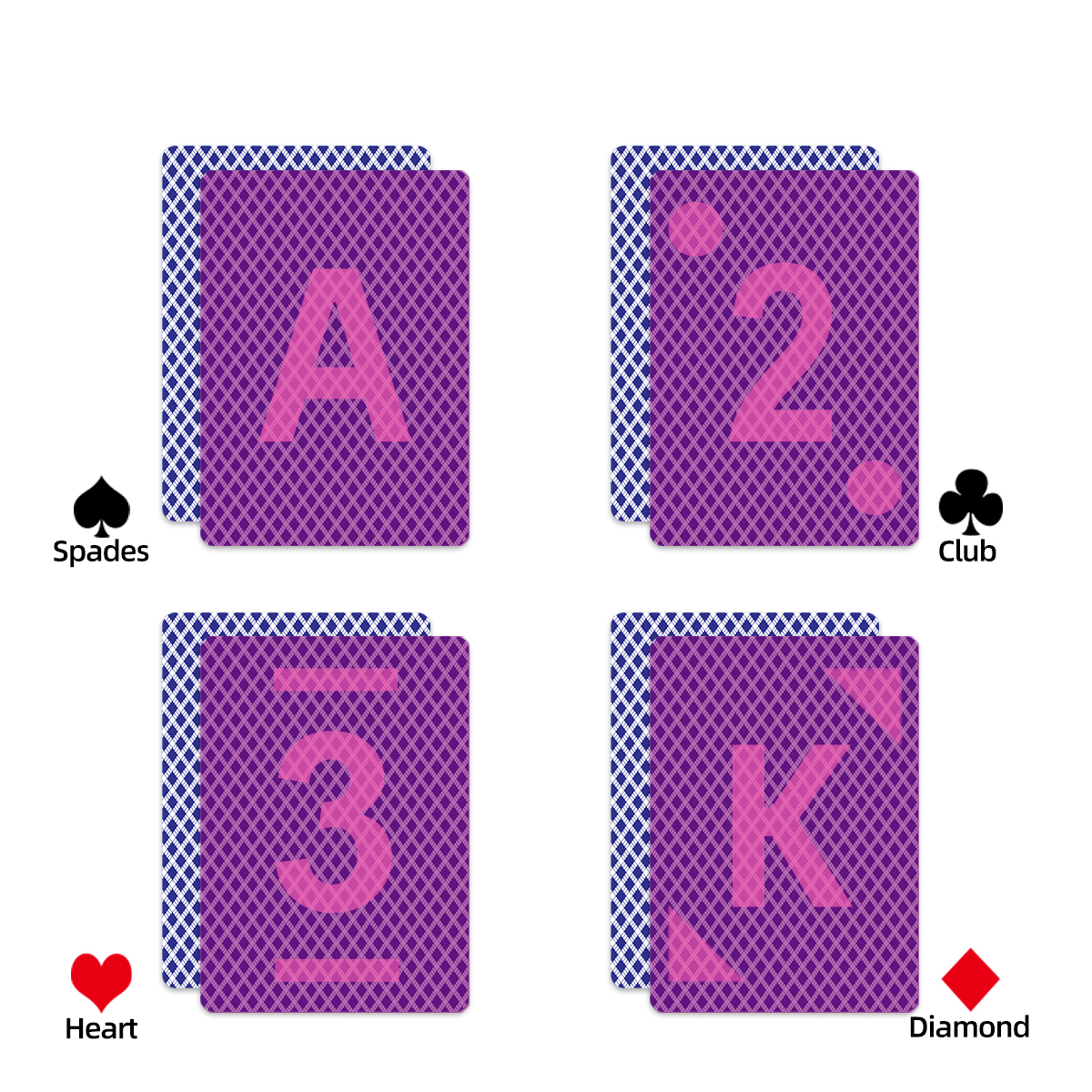
- Marking application: Luminous ink is applied to specific areas of the card back using precision printing equipment. The ink pattern encodes the card’s suit and value.
- Finishing: A protective coating is applied over the markings to ensure durability and prevent the ink from wearing off during handling.
- Quality control: Each card is inspected under both normal and IR/UV lighting to verify marking accuracy and invisibility.
Marking Systems: Luminous Ink vs Barcode
Luminous Ink Marking
Luminous ink markings are the traditional and most widely used system. The ink is formulated to be invisible under normal visible light but glow brightly when illuminated by specific wavelengths (typically infrared in the 700-1000nm range). The markings are typically small dots or symbols placed at specific positions on the card back, with the position and pattern encoding the card’s identity.
Barcode Edge Marking
Barcode marking is a newer approach that prints tiny barcode patterns along the card edges. These patterns are designed to be read by camera-based analyzer systems rather than human eyes. Barcode systems offer faster reading speeds and can encode more information than standard dot-pattern luminous ink systems, but they require electronic reading equipment.
Reading Methods for Marked Playing Cards
There are three primary methods for reading marked playing cards:
- Infrared contact lenses: Wearable lenses that filter visible light, making luminous ink markings appear bright against a darkened background.
- Filtered glasses/sunglasses: External lenses that achieve the same effect as contact lenses but in a more accessible form factor.
- Electronic camera systems: Miniature cameras (button cameras, watch cameras) connected to analyzer units that process the images digitally and decode the markings automatically.
Durability and Performance Factors
The performance of marked playing cards depends on several factors:
- Marking longevity: Premium marked cards maintain clear markings for 3,000-10,000 shuffles depending on handling.
- Reading distance: Entry-level cards readable at 20-40cm; professional cards readable at 1-2 meters.
- Environmental tolerance: Marking visibility can be affected by extreme humidity, direct sunlight, and certain cleaning chemicals.
- Card stock compatibility: The marking process should not alter the card’s feel, weight, or flexibility relative to standard cards.
Comparing Marked Card Brands and Types
The marked card market offers products across several quality tiers. Entry-level luminous ink cards provide basic functionality at an affordable price point. Mid-range cards offer improved marking durability and reading clarity. Professional-grade cards feature premium card stock from manufacturers like Modiano or Copag, with advanced luminous ink formulations and multi-spectrum compatibility.
Barcode-marked cards represent the premium end of the market, designed specifically for electronic analyzer systems. These cards typically cost 2-4 times more than luminous ink cards but offer faster reading speeds and compatibility with the most advanced analysis systems.
Detection Awareness
Understanding how marked cards can be detected is important for both users and game hosts. Standard detection methods include UV light inspection, magnification comparison of card backs, edge examination for barcode markings, and wear pattern analysis. Professional card rooms employ multiple detection layers to identify marked cards before they enter play.
Conclusion
Marked playing cards represent a sophisticated intersection of printing technology, optics, and game mechanics. Whether used for magic, security training, or card study, understanding the types, manufacturing quality, and reading methods helps users make informed decisions about which products best suit their needs.
 English (United States)
  English (Australia)
  Japanese